
Share insight


insight
Universities are under pressure to translate enthusiasm for generative AI into practical decisions about where to invest, how to manage risk, and what changes will be required across professional services. Yet many institutions are trying to make those decisions with an incomplete view of the work. They understand professional services through roles, reporting lines and organisational units, while GenAI changes work at the level of activities and tasks.
This creates a deeper challenge for universities in assessing and planning for the impact of AI on the professional services workforce. GenAI will not simply eliminate tasks; it will reshape roles. As parts of current work are automated or augmented, institutions will need to decide what those roles should become, what capabilities will matter more, and how services should be organised around changed work. Organisations that are thinking ahead are already asking: if 30 per cent of a team’s current tasks will be impacted by AI in three years, what does that function need to look like and do we redesign now or react later?
An activity-based lens provides a stronger foundation for thinking about GenAI adoption because it helps universities understand both need and impact. It shows where work is repetitive, information-heavy or rules-driven enough for AI to reduce effort or improve consistency. It also shows where judgement, coordination and service context remain central, making augmentation more realistic than full automation. Most importantly, it makes visible how work is distributed across roles and teams, which is essential if institutions want to redesign jobs, capabilities and service models rather than simply layer new tools onto existing structures.
Why a role-based view is not enough
Most workforce and service data in universities sits in HR and finance systems and organisational charts. These are important for governance and accountability, but they say little about what staff actually do. A single role may combine routine administration, advising students or staff, problem solving and data interpretation, each with very different suitability for GenAI to support. Equally, a single activity such as preparing school, faculty and portfolio reports, managing course rules and entry requirements or processing ethics approvals may be spread across multiple roles and teams. This is why role-level analysis is often too blunt to support good AI decisions.
Research and emerging practice both suggest that GenAI is often most useful when applied to specific components of work such as drafting, summarising, synthesising information and supporting decisions, rather than replacing whole jobs outright.¹ This means the key unit of analysis is not the role or team, but the underlying activity. An activity-based view therefore provides a more realistic basis for assessing where AI can augment work, where it may automate parts of a process, and where human-led expertise remains essential.
Understanding need and impact more clearly
Taking an activity-based view helps universities answer four practical questions:
- Where is there the greatest potential for GenAI? This starts with where GenAI is genuinely well suited: activities that are repetitive, information-heavy, rules-based or language-driven, where it can speed up work, improve consistency or lift quality.
- Where is there genuine need for GenAI? This is about identifying activities where workload pressure, process friction or service inconsistency create a case for change.
- Where is the likely impact greatest? High-potential use cases get more buy-in when they apply to activities that consume material time and effort across the institution.
- What would successful adoption require? Understanding who performs an activity, how consistently it is delivered and how tightly it connects to adjacent work helps leaders gauge implementation complexity before investment decisions are made.
To help answer these questions, Nous Data Insights has examined the potential for AI to augment and automate each activity in the UniForum Activity Framework, which catalogues 175 professional services activities across university functions. An activity in our framework is defined by a detailed set of tasks, allowing for nuanced assessment. A large language model was used to score each activity’s potential for augmentation and automation on a scale from zero to one, explicitly drawing on established academic research including by the International Labour Office and the World Economic Forum² into AI’s impact on occupations. Higher augmentation scores indicate stronger potential for AI to assist staff in delivering tasks, while higher automation scores indicate greater potential for GenAI to undertake tasks with appropriate human oversight.
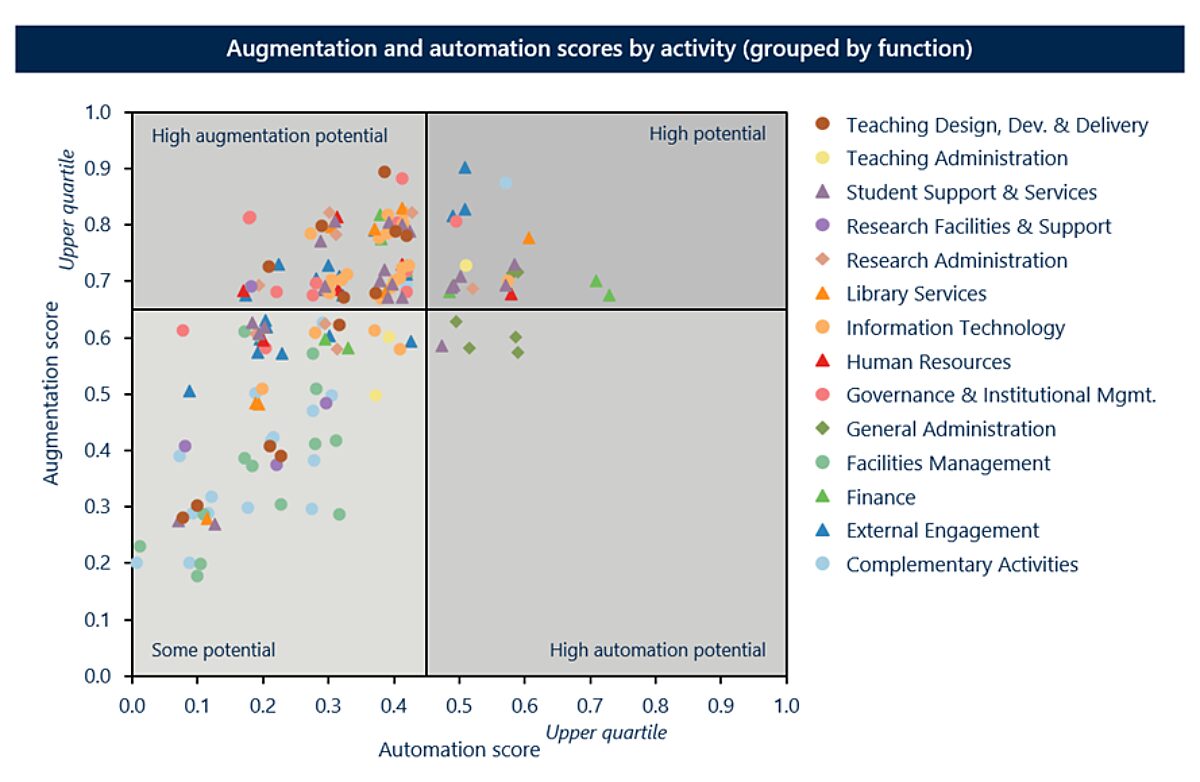
Our assessment suggests a few interesting findings. First, that AI potential is spread broadly across professional services (with some outliers) rather than concentrated in a small number of back-office functions. Across many activities, GenAI can reduce routine effort while also improving consistency, responsiveness and quality. This suggests the opportunity is institution-wide, not limited to a few administrative processes.
Secondly, the pattern of impact differs by activity. Some activities show stronger potential for augmentation, particularly those involving synthesis, drafting, judgement support and information management. These include areas such as policy and strategy development, advanced analytics, teaching design, IT asset management and aspects of student support. Other activities show stronger potential for automation, especially where work is more repetitive, rules-based and transaction-heavy. These include areas such as travel and reimbursements, payroll, service desk support, records management, and parts of enrolment administration.
Importantly, the assessment shows that augmentation and automation are not mutually exclusive. The same activity may contain elements of both, depending on how the work is structured and how AI is applied. In financial accounting and reporting, for example, routine reconciliations may be automated, while AI can assist with drafting commentary and supporting analysis.
Taken together, our findings suggest that the greatest gains are likely to come not from wholesale automation, but from targeted AI adoption across a wide range of activities. This is why an activity-based lens is more useful than a generic list of AI use cases: it helps universities identify where AI need is strongest, where impact is likely to be greatest, and where investment is most justified when considered alongside effort, scale and change complexity.
Designing roles around changed work
A clearer understanding of activities also matters because GenAI adoption is both a technology and a workforce design decision. When parts of an activity are automated or augmented, the role that contains that activity changes as well. Some roles may shift towards exception handling, judgement, relationship management or quality assurance. Others may require stronger data literacy, prompt design, policy interpretation or service orchestration capabilities. Without an activity-based view, universities risk introducing AI tools without adequately redesigning roles, workflows and expectations around them.
This is particularly important in university professional services, where work is interdependent and service quality depends on coordination across teams. A change to one activity can have ripple effects on adjacent activities, handoffs and accountabilities. Understanding work at the activity level helps universities anticipate those effects, engage the right staff groups, and plan for reskilling or redeployment where needed.
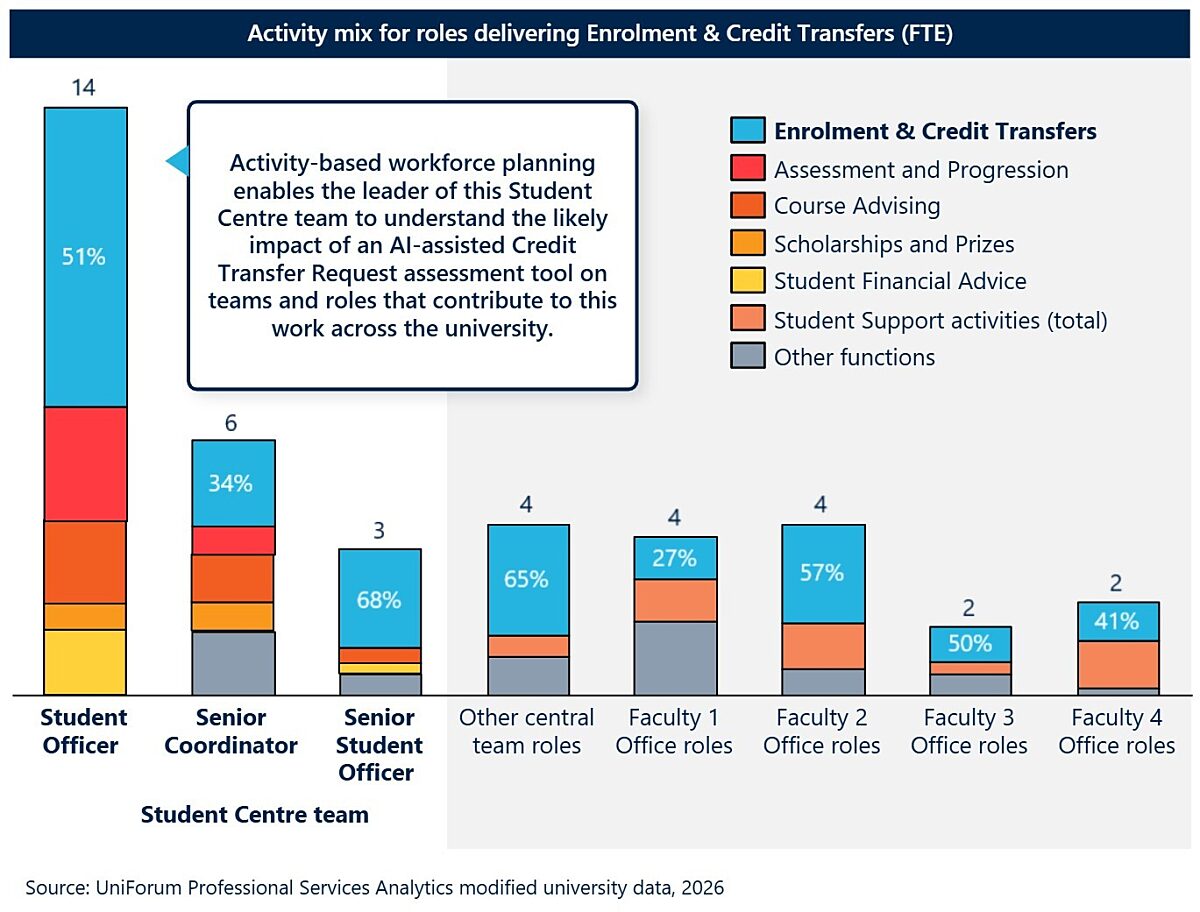
Take the Student Centre team example below. Looking only at Enrolment and Credit Transfers may suggest a plausible AI use case, but it misses how work is distributed across the team and the broader university. The chart shows that staff effort in different roles spans multiple activities in the Student Centre, and that the same activity can sit across different roles, with contributors to the process also sitting in other central and faculty teams. This makes it easier to see not only where AI might help, but also how changes could affect capacity, service delivery and role design across the team.
Crucially, an activity-based approach supports strategic workforce planning. Rather than asking how many roles might be displaced, leaders can ask how activities will change, which capabilities will become more important, and where reskilling, redeployment or role redesign may be needed. This shifts the conversation away from cost reduction alone and towards sustaining professional services capability as work changes because of AI. It also provides a clearer basis for planning how staff can spend more of their time on higher-value work, while universities manage the broader implications of changing task allocation, capability needs and human-digital collaboration.
From experimentation to informed adoption
For universities, the challenge is no longer whether GenAI matters, but how to adopt it in ways that are targeted, credible and sustainable. That requires understanding work at the right level of detail. The activity-based lens that UniForum provides enables institutions to identify where AI can make a meaningful difference using benchmarked data on professional services resourcing, understand the likely operational and workforce impact in terms of where and how the work is being delivered, and redesign roles accordingly. It also provides a better basis for measuring whether adoption is delivering real value over time through its annual collection model and consistent methodology. Without that data-informed foundation, universities are more likely to rely on pilots, fragmented requests and assumptions about roles that obscure where GenAI can genuinely improve professional services.
By showing how effort is distributed across activities, roles and service areas alongside cost and capacity benchmarks, the UniForum activity-based dataset gives universities a practical foundation for prioritising use cases, sequencing change and redesigning work as GenAI adoption matures. Used well, this evidence can support more confident governance, targeted investment choices and a more deliberate approach to reshaping professional services for the years ahead.
References
¹ Gmyrek, P., Berg, J., Bescond, D. Generative AI and jobs: A global analysis of potential effects on job quantity and quality. ILO Working Paper 96. Geneva: International Labour Office, 2023. Battista, A., et al. Jobs of Tomorrow: Large Language Models and Jobs. White Paper. Geneva: World Economic Forum and Accenture, 2023.
² Ibid. (WEF and ILO), and Felten, E., Raj, M., Seamans, R., “Occupational Heterogeneity in Exposure to Generative AI,” 2023.
AI tools have been used to support aspects of this publication. The insights and judgement represented in this article are those of Nous Data Insights, with all outputs reviewed by Nous Data Insights team members and editors to quality assure the analysis, references and language used.
Contact us to explore how UniForum is supporting universities to redesign work in the age of GenAI.
Authors

Adam Gray
CEO
Adam is an expert in strategy, transformation, and operational performance and one of Australia’s leading higher education consultants. He is a trusted advisor to many leading universities.


Sarah Connelly
Managing Director, ANZ
Sarah has more than two decades of experience leading and managing transformational projects and programs.

Tim Andrews
Director
Tim Andrews is a Director with Nous Data Insights, drawing on eight years’ experience working in the university sector across the UK, Australia and New Zealand.