
Share insight


insight
Universities are rethinking their taught portfolios because the academic offer is becoming harder to explain, harder to deliver and harder to change.
Students are bringing more varied circumstances, patterns of participation and expectations to their studies. As universities redesign curriculum, assessment, pedagogy and student support, the portfolio beneath that work matters: the programmes, modules, pathways and rules through which students move and through which learning is structured and change is delivered.
Historically, teaching portfolios have developed incrementally through decisions about individual offerings. Each component may be academically strong, but the portfolio as a whole can become difficult for students to navigate and complex for institutions to change. This raises a more searching question about whether the structure of the academic offer supports students to progress or introduces complexity that makes success harder. In England, the Office for Students has made student continuation, completion and progression explicit regulatory requirements, adding urgency to this question.
Portfolio improvement should therefore be judged by more than whether it removes low-volume offerings. Indeed, the deeper question is whether the portfolio gives students coherent pathways, academics workable structures and the institution a platform for ongoing educational improvement.
Our work with institutions points to five connected lenses that help move portfolio conversations from broad agreement to focused action: strategic intent, delivery effort, architecture, evidence for trade-offs and decision governance.
1. Shape intentionally: align size and mix to mission and demand
The right portfolio is not always the smallest portfolio. Breadth has the potential to support mission, regional influence, research strength, student demand or disciplinary distinctiveness. The challenge is whether that breadth is intentional.
Over time, portfolios can come to reflect what different parts of the university are equipped or motivated to offer more than the institution’s collective strategy. A stronger process brings purpose back into focus by testing where the university intends to build depth, maintain breadth or consolidate provision.
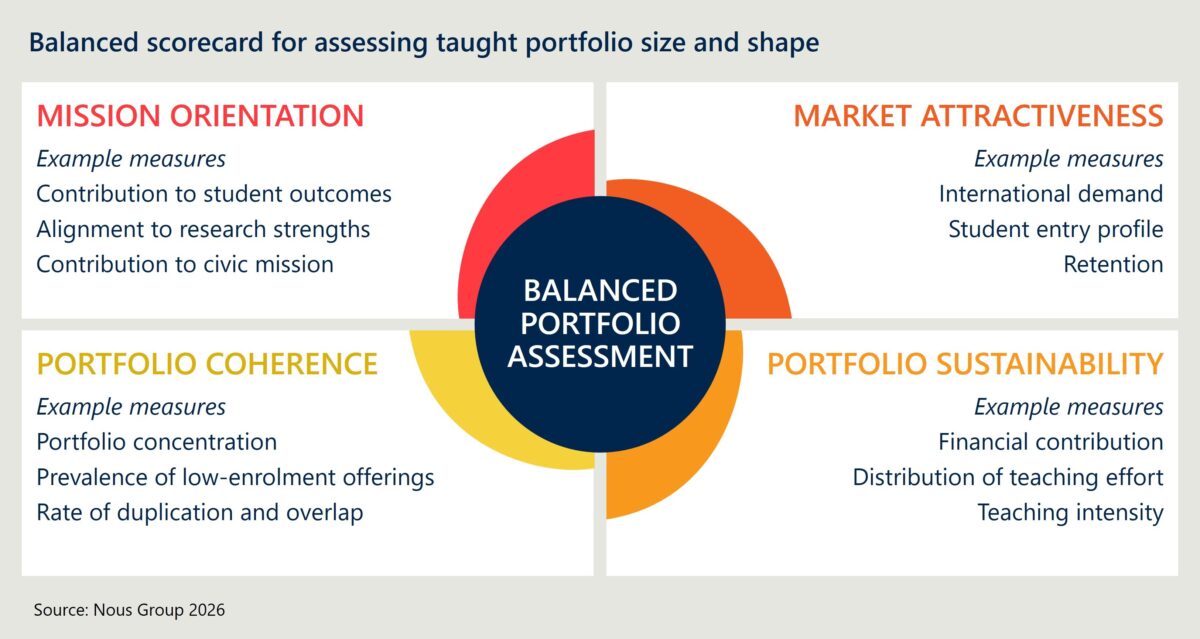
A balanced scorecard can make those choices more consistent by bringing together measures of mission orientation, market attractiveness, portfolio coherence and productivity. This allows each offering to be considered on its own merits and in the context of the wider portfolio. A programme may perform strongly in isolation, for example, while adding limited distinct value alongside several similar offerings. The scorecard helps identify provision that warrants investment or protection, as well as areas where overlap or accumulated complexity should be reconsidered.
2. Find the effort: use module-level analysis to locate delivery complexity
While the programme-level review remains necessary, it often misses where much of the work is generated. Teaching effort is created through individual modules: small cohorts, duplicated content, repeated delivery, assessment patterns, optionality and local variations in contact hours.
UniForum Teaching Effort Analytics shows that universities with larger module portfolios often carry higher teaching loads for comparable student numbers, particularly for certain disciplines. This is because every module carries a fixed effort cost (content must be prepared, teaching coordinated and assessment managed) whether enrolment is large or small.
Module-level analysis gives universities practical levers for change. It can reveal duplicated teaching, fragmented choice, repeated activity or small offerings that add effort without clear student or strategic value. It also protects against blunt cuts by showing where small or specialist provision is deliberate, necessary or distinctive.
The opportunity is to simplify delivery without automatically narrowing the student offer. Programme breadth can often be preserved while the module portfolio beneath it becomes more focused, sustainable and effective.
3. Design for interoperability: make the portfolio work as an architecture
Delivery complexity is often sustained by the education architecture (or lack of architecture) beneath the portfolio. The architecture comprises the rules and structures that determine how programmes are built, how modules fit together and how students move through the offer. When those rules are unclear or inconsistent, students can face unnecessary complexity in understanding their choices, navigating pathways and progressing through a course.
A strong architectural framework makes those rules explicit, clarifies the core components of the offer – programmes, majors, pathways, modules (units), electives – and how they combine.
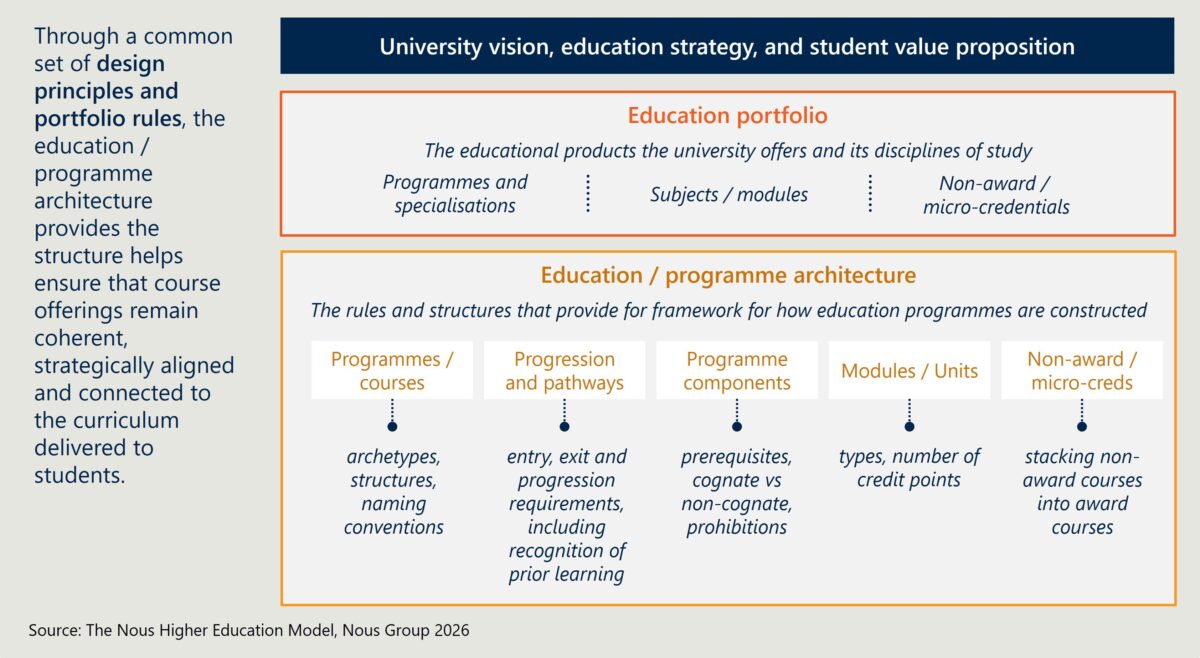
Designing for interoperability means deciding where common structures would create value, for example shared modules, consistent credit points, common progression requirements, elective space, and service teaching.
Interoperability also allows students to make greater use of the breadth within the portfolio. Compatible structures can enable students to combine learning across disciplines, whether to support a particular career direction or pursue interests beyond their primary field of study. Without that flexibility, a university may offer considerable breadth (and complexity) while students remain largely confined to the provision within their own programme.
When this is done well, the portfolio becomes easier for students to navigate and progress through, while also giving them greater scope to shape an education around their interests and intended futures. For the institution, it provides a more adaptable platform for educational change.
4. Use evidence to make trade-offs explicit
Portfolio improvement involves real trade-offs between student choice, academic identity, disciplinary difference, workload, income, complexity and strategic positioning. These cannot be managed well through principles alone. Leaders need evidence that is specific enough to support action and credible enough to support discussion with academic communities.
Useful evidence should make the main choices visible: where demand is strong enough to justify breadth, where delivery effort is disproportionate, where student choice is meaningful or confusing, where flexibility can be sustained without additional cost, and where financial or strategic pressure changes the judgement.
This is where benchmarking matters. Internal data can show where complexity sits but external comparison helps leaders test whether that complexity is unusual, explainable or a sign of avoidable fragmentation.
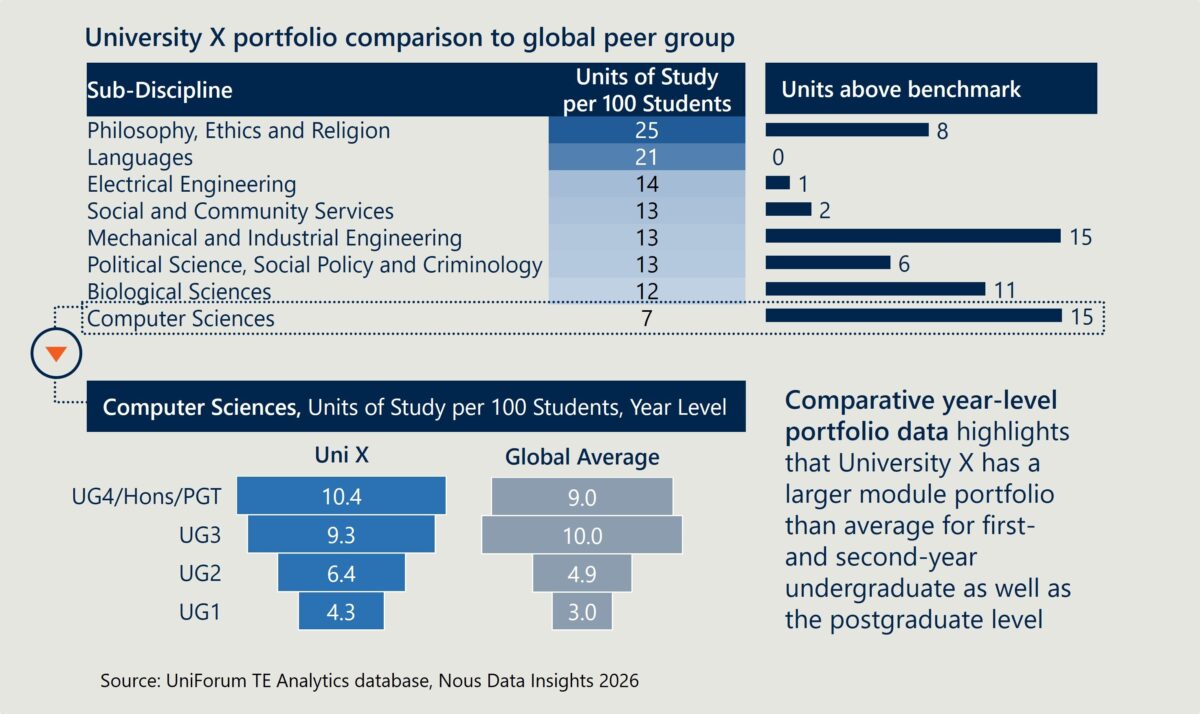
The aim is to make choices explicit so leaders can decide where to invest, simplify, consolidate, pause or protect provision with a clearer view of the consequences.
5. Govern continuously: give academic leaders decision rights and guardrails
Academic review processes typically assess programmes and modules on a periodic basis. These processes are important for academic integrity, but they often look at individual offerings in isolation, asking whether a programme remains viable, whether a module meets certain criteria for quality, or whether specific curriculum changes should be approved.
A more strategic approach needs a whole-of-institution view of the taught portfolio, but that does not mean it has to be entirely centrally led. Academic leaders are the domain experts, and they need to be empowered to make evidence-based choices about what to refresh, simplify, combine, protect or phase over time, while working within a common institutional frame.
Clear decision rights and guardrails make that balance possible. Academic governance and executive management should agree the institutional policy and architectural expectations, informed by academic expertise. These should define which decisions sit with faculties and schools, what evidence is required, when exceptions are permitted and which issues need institution-level coordination.
Within this framework, academic leaders can be empowered and held accountable for using robust evidence to design and manage provision. Making that evidence and the rationale for decisions visible through governance processes provides appropriate scrutiny, particularly where exceptions or institution-wide consequences arise. This turns portfolio improvement into a routine leadership discipline that is locally owned and coherent at the institutional level, rather than a periodic clean-up exercise.
From review to sustainable improvement
Improving the taught portfolio is ultimately about making the institution more able to act. As student needs, expectations and patterns of participation continue to shift, universities need an academic offer that can evolve without every improvement being slowed by fragmented structures, accumulated complexity or disconnected local decisions.
The five lenses provide a practical route from review to sustained improvement. They help institutions clarify what they are trying to build, understand where teaching effort is generated, design an architecture that connects the offer, use evidence to make trade-offs explicit and give academic leaders the decision rights and guardrails to keep improving the portfolio over time.
The result is a portfolio that is clearer for students, more sustainable for academics and more adaptable for the university. That is what turns portfolio review from a periodic exercise into a platform for better student outcomes and ongoing educational change.


