Share insight


insight
Better decisions on teaching reform start with a credible baseline
Universities are under pressure to make increasingly consequential workforce and teaching delivery decisions that are evidence-informed, defensible and scalable, often while working with data that is still evolving. As financial and workload pressures intensify, many institutions face a difficult tension: the need to act now, despite underlying data that remains incomplete or lack of alignment about the way forward.
The instinct to wait for a better time or clearer information is understandable, but delaying action does not remove risk; it simply shifts decisions onto less transparent evidence, local assumptions and anecdotal perspectives. In practice, institutions cannot afford to postpone workforce and teaching reform until data is perfect. What they need is a credible baseline that enables more defensible decisions today and can be refined over time.
For many universities, teaching effort is the most practical place to start because it sits at the intersection of academic workload, teaching delivery, workforce planning and financial sustainability, making it one of the most valuable foundations for building a shared evidence base. Teaching Effort Analytics can help universities establish that baseline quickly, supporting more confident decision-making now while laying the groundwork for broader reform.
A sector still building its data foundations
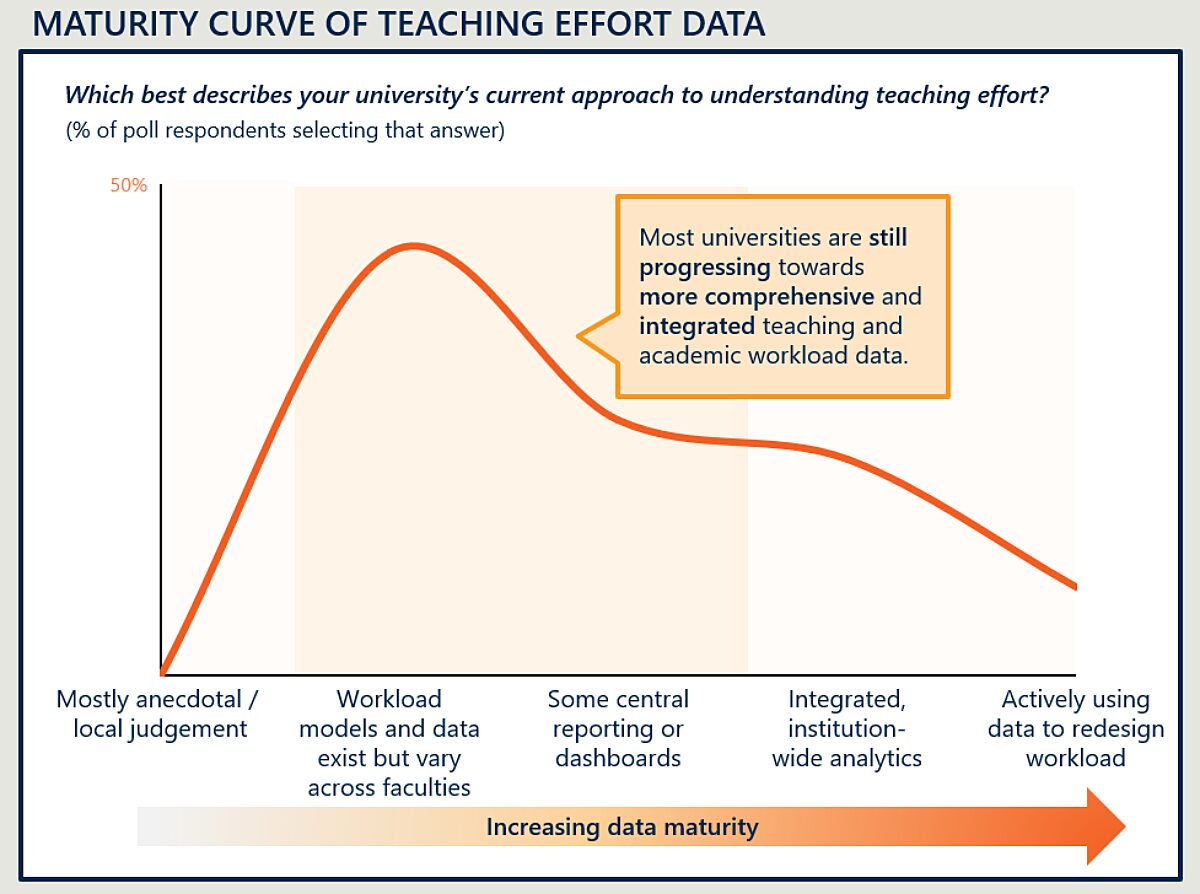
Despite broad recognition of the importance of data-informed decision-making, only a small proportion of universities have good data on how academic effort is distributed and what drives it, and use that data to support sustainable workloads. At a recent executive roundtable for Australian and New Zealand universities, most senior leaders rated the maturity of their current data capability in this area much lower.
As shown in Figure 1, around two thirds of institutions said that they are working with data that is sometimes fragmented, such as academic workload models that vary by school in both structure and documentation, alongside some level of central reporting or dashboards. Institutions that see themselves as more mature have often arrived there through sustained investment over several years in data, capability and governance.
Yet across the spectrum, many universities are grappling with similar questions about academic workload pressure, constrained resources and expectations around student experience and outcomes. These are all areas where a more evidence-informed view can be helpful, even if the underlying data is still improving.
The reality is that decisions cannot wait for perfect data or complete alignment
In an increasingly constrained environment, universities are being asked to make difficult trade-off decisions related to workforce, teaching delivery, portfolio and financial sustainability. These are decisions that cannot be postponed and so the choice becomes whether to make them from a transparent institutional baseline, or from assumptions that remain largely hidden and untested. The latter makes it harder to know where intervention is needed, which trade-offs are justified, and whether decisions are being applied consistently and equitably across the institution. Some of the risks are:
- Decisions continue, even when the evidence base is incomplete
Budget, workforce and portfolio decisions can’t pause while data is being improved. Without a shared baseline, institutions often fall back on spreadsheets, proxies and professional judgement, which may be useful but are not always transparent or repeatable. - Data issues become harder to resolve over time
When data challenges are worked around rather than addressed, local fixes multiply, definitions diverge and inconsistencies accumulate. Over time, this makes the data environment more fragmented and harder to improve. - Trade-offs are harder to explain and defend
Without a shared baseline, leaders still need to make difficult decisions, but it becomes much harder to explain why some areas are under greater pressure than others. This can weaken confidence in the rationale for change and make reform slower and less effective. - Academic leaders lack the visibility they need
Most importantly, Faculty Deans, Associate Deans, Heads of School and Heads of Department are expected to manage resourcing day to day, often without a shared, reliable view of teaching effort. That makes it harder to identify pressure points early, act consistently and lead change with confidence.
Seen this way, waiting is not a neutral choice. It can also mean delaying the shared understanding that institutions need to make thoughtful decisions.
Why teaching effort can be the most effective place to start
Through Nous Data Insights’ work with universities, we have found that the starting point for workforce and teaching reform is a clear framework to understand and compare teaching workloads and drivers.
Teaching effort sits at the intersection of several important institutional concerns, including workload equity and sustainability, academic staffing mix and casualisation, course and unit design efficiency, and student demand and funding constraints. Looking at teaching effort can therefore help bring workforce, workload and teaching activity data into closer alignment.
This can begin by bringing together core datasets that already exist in most universities, even if they are not always centrally captured or well aligned:
- Academic workforce data (who is employed, at what level, and in what capacity)
- Workload allocation data, in whatever form(s) it exists across the university (how academic time is allocated across teaching, research and service)
- Student and teaching activity data (what is being delivered, to how many students, and at what level)
Aligning and linking these datasets produces a consistent, comparable view of how teaching effort is generated across the institution. This enables universities to move from fragmented, faculty-specific reporting to a shared, institution-wide baseline for decision-making.
We have found that much of the early value lies in making data more usable and consistent, rather than perfectly complete. As Professor Nicki Lee notes in the article Academic workload planning, “When you have data that stakeholders can read, understand, recognise and count on, it’s so much easier to generate engagement and support at various levels of the organisation.” Universities often gain clearer visibility into where workload allocations are inconsistent, where teaching activity is not fully captured, and where different parts of the institution are working from different definitions. These insights are not always obvious until a structured data collection and validation process begins.
Case study: building a usable baseline from fragmented workload data
One university entered the Teaching Effort Analytics program with a fragmented and incomplete view of their academic workload models. The closest proxy covered a subset of academic staff through a periodic workload collection, while central teaching allocation data was widely understood to be incomplete, inconsistent and out of date.
Rather than treating that as a reason to delay, the institution used Teaching Effort Analytics to assemble a workable evidence base from the data they did have. Schools were invited to contribute in three different formats depending on data availability:
- full workload allocation models for central review,
- summarised staff-level workload and subject split data, or
- high-level role-based allocations that could be applied by department
Responses were mixed, but enough detail was gathered to begin building an institution-level view. The team undertook a thorough central review of the returned data and applied a set of practical assumptions to complete the institutional dataset.
The result was not perfect data, but a decision-useful baseline that leadership could actually work with. It made visible where schools had strong underlying information, or where the university was relying on assumptions, and highlighted areas where local workload models were likely masking teaching risk.
Just as importantly, the process created a repeatable method for improving the dataset over time. Despite starting with a less mature data environment, the university is using Teaching Effort Analytics as a practical way to turn fragmented local files, imperfect system records and pragmatic assumptions into a coherent baseline for decisions about teaching sustainability, workforce planning and portfolio management.
From fragmented data to better decisions
When teaching, workload and student data are brought together in a consistent way, universities gain a practical baseline for decisions they already need to make. That baseline can help answer critical questions that are often clouded by incomplete information and unclear trade-offs:
- Where are academic workloads uneven or unsustainable, and how can this be addressed?
- Which disciplines or units are structurally high-effort for staff and students, and why?
- How much teaching capacity do we need for our current and future student load?
- Do we have the right portfolio size and shape for our student load?
- Are the changes we are making delivering the desired benefits?
This baseline becomes even more useful when universities can compare their patterns with peers facing similar pressures. Benchmarking helps leaders distinguish between challenges that are institution-specific and those that reflect broader sector conditions, making it easier to target action where it will matter most.
For universities unsure whether their data is mature enough or the conditions for change are ideal, there is a clear next step. It is to understand what your current data can already support, where the biggest gaps are, and how quickly a more credible baseline could be built to support good decision-making. Nous Data Insights can support a focused diagnostic conversation to help clarify where you stand today and what a practical path forward looks like.