
insight
This article first appeared in the October 2, 2026, issue of The Chronicle of Higher Education.
For decades, faculty members have sounded the alarm over rising administrative costs. They’ve objected to expanding bureaucracy — the proliferation of rules, processes, and layers of middle management — and the migration of authority and money from academic units to central administration. Books like Benjamin Ginsberg’s The Fall of the Faculty and essays like Paul F. Campos’s “The Real Reason College Tuition Costs So Much” in The New York Times and Derek Thompson’s “No One Knows What Universities Are For” in The Atlantic occasionally carried the argument beyond campus, but it never became a sustained public concern. Nicholas Zeppos, chancellor emeritus of Vanderbilt University and adviser to Nous Data Insights, worked in academic leadership for three decades, and encountered it most often in faculty senates, occasionally in boardrooms, and rarely — if ever — in conversations outside the academy. Administrative bloat was, for the most part, inside baseball.
That is no longer the case. Administrative costs have moved to the forefront of public debate and become a public-trust issue. Vanderbilt University’s June 2026 Unity Poll, conducted by SSRS, asked 1,030 adults from a national sample their opinions on higher education: 37 percent identified growth in administration and bureaucracy as a leading cause of high college costs — more than twice the share that blamed faculty salaries and benefits. Respondents also ranked decisions by college administrators as the largest source of problems in higher education. As this spring’s “Report of the Yale Committee on Trust in Higher Education” put it: “In public discourse, the most common critiques [of rising costs] point to administrative bloat, spending on buildings, and the ‘corporatization’ of the university.” The public wants to know if colleges are exercising discipline and sound stewardship over the resources entrusted to them, or whether they are failing in their responsibility to manage their overhead.
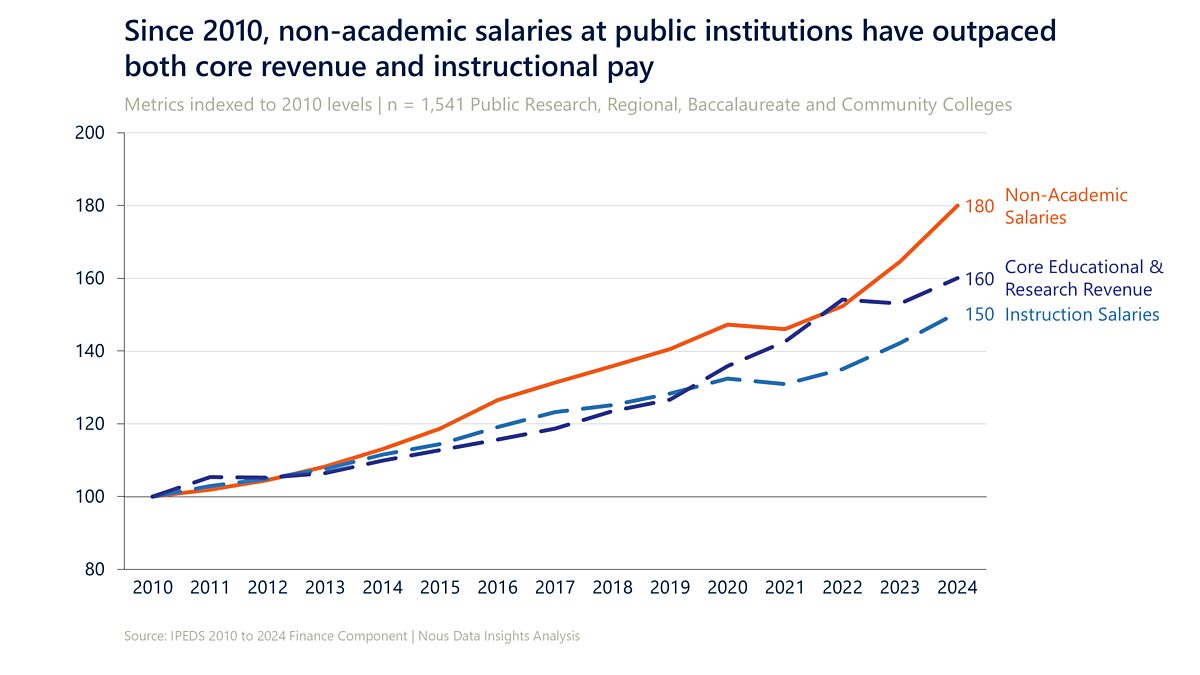
The public is right to demand answers. Our analysis of National Center for Education Statistics data found administrative and support salaries grew faster than instructional salaries across every major sector of higher education. We tracked three categories: academic support (deans’ offices, advising, libraries, and academic technology); student services (admissions, financial aid, counseling, and student life); and institutional support (central administration, finance, human resources, legal affairs, procurement, and communications). Between 2010 and 2024, payroll for these functions increased 88 percent, compared with 57-percent growth in core institutional revenue and 54 percent in instructional salaries. Over the same period, administrative and support salaries rose from 60 cents to 74 cents for every dollar of instructional salaries.
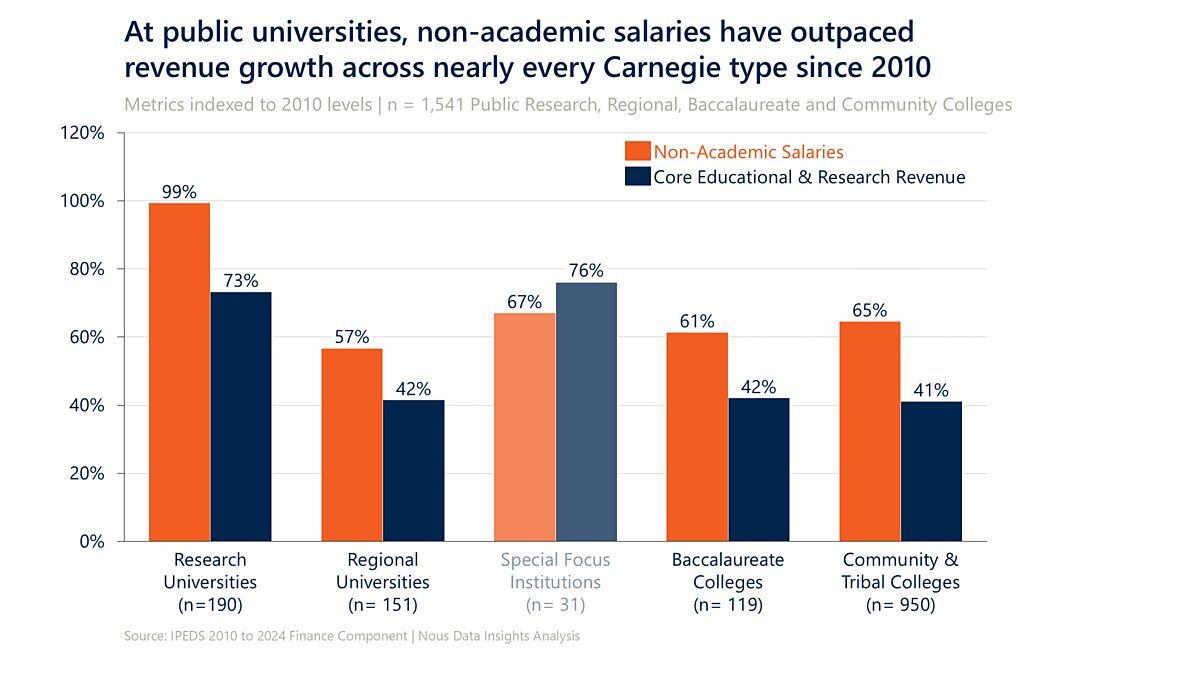
The divergence was especially pronounced at research universities. Across the 146 public and private institutions we examined over that period that were classified as having very high research activity (in the 2021 Carnegie Classification), payroll for the three functions increased 121 percent, compared with 76-percent growth in core revenue and 78 percent in instructional salaries.
Administrative and support payroll more than doubled at 81 universities and more than tripled at 13. At 76 institutions, growth in administration exceeded both core-revenue and instructional-salary growth by more than 20 percentage points. Among these research universities, institutions without medical schools often spent as much on administration as comparable institutions, suggesting that medical-school status alone explains little after accounting for institutional scale, revenue, and the mix of teaching and research.
The data also reveal where the growth occurred. By function, academic support — not central administration — grew fastest and accounted for nearly half of the additional support spending. By occupation, business and financial functions, management, and the category encompassing legal, media, sports, arts, and community service grew nearly 57 percent, compared with just 9.1 percent across the remaining noninstructional occupations. The management trend is consistent with longstanding faculty frustration over proliferating layers of middle managers — layers that add not only payroll but reviews, approvals, handoffs, and steps to routine processes.
Regulation is often offered as the principal explanation for administrative growth, and its costs are certainly material. An earlier Vanderbilt-led study, commissioned by Nicholas Zeppos, found that federal compliance costs ranged from 3 to 11 percent of nonhospital operating expenditures across 13 institutions selected as representing a broad cross-section of higher education, with research-intensive universities generally on the higher end of that spectrum. Particularly costly areas included federal grants and contract administration and accounting, accreditation necessary for Title IV-funding eligibility for financial aid, while campus safety and civil-rights requirements added additional costs. More recently, federal Title VI oversight has placed institutional-research funding at risk, leading to costly litigation or large settlements that are accompanied by monitoring, certification, and reporting regulations. And a newly finalized regulation on earnings accountability will place considerable system and staff burdens on universities.
This is all to say that regulation and compliance are indeed expensive and continue unabated. But our more recent analysis of federal data shows that the median share of expenditures devoted to institutional support, student services, and academic support is 29 percent — far above the 3 percent to 11 percent cost of regulation found in the 2015 Vanderbilt study. Regulation is only one component of a much larger cost base and does not explain its full scale.
A fuller explanation lies in governance and organizational design. In an earlier Chronicle essay, “Why Your University Has So Many Administrators,” Nicholas Zeppos argued that growth in administration rarely reflects bad intentions or a deliberate decision to build a larger bureaucracy. Costs and performance are difficult to see, responsibility is dispersed, and leaders often cannot determine when additional capacity is justified. As the Yale trust report admitted, “We reviewed Yale’s internal records on administration and staffing and found that answering even basic questions proved remarkably difficult.”
Nicholas Zeppos saw this repeatedly as provost and chancellor. Many talented deans became outstanding “pothole fillers,” responding to each new challenge by adding a position, process, or local service, while central offices expanded many of the same functions. A recent Harvard report found that research-administration support was distributed across five different offices at various levels of the institution. Each decision probably seemed sensible, but no one stepped back to redesign the entire road. The result was an administrative organization no one had intentionally designed.
Then there are the familiar sawtooth patterns that mark failed efforts to contain administrative cost. Budget crises bring hiring freezes, position eliminations, and across-the-board cuts; when the pressure passes, spending snaps back as units rebuild the capacity they still believe they need. The Covid-19 pandemic offered a revealing example. Using our same sample of 146 institutions, we observed that the 2021 fiscal year recorded the lowest increase in administrative-support payroll between 2010 and 2024 — just 0.8 percent. Over the following three years, however, payroll grew at an annualized rate of 9.6 percent, the fastest sustained increase of the period. The crisis had simply constrained administrative growth, not re-engineered the administrative enterprise.
The pattern is difficult to break because administrative work is fragmented across central offices and academic units. That fragmentation becomes especially costly as institutions grow. Instead of achieving expected economies of scale, support payroll has grown faster at many larger institutions than at their smaller counterparts. By contrast, our analysis of universities in Canada, the United Kingdom, and Australia found that leading institutions achieve economies of scale despite facing similar decentralization, shared governance, research complexity, regulatory obligations, and service expectations. The difference is found in how they govern administrative work.
The lesson from abroad is simple: Administration must be governed function by function, not as a single budget category. Each function should have its own cost structure, service expectations, and opportunities for redesign. Effective institutions make those functions visible across the university wherever their people and costs reside. Using common definitions and role-level data, they compare costs and service quality, identify unnecessary variation, standardize transactional work, and assign accountability. Payroll, accounts payable, IT support, admissions processing, course scheduling, facilities and space management, and post-award research administration can achieve economies of scale when designed end to end rather than separately by each unit. That is precisely what we’ve seen internationally. Local flexibility is preserved where it adds value — not where it perpetuates duplication.
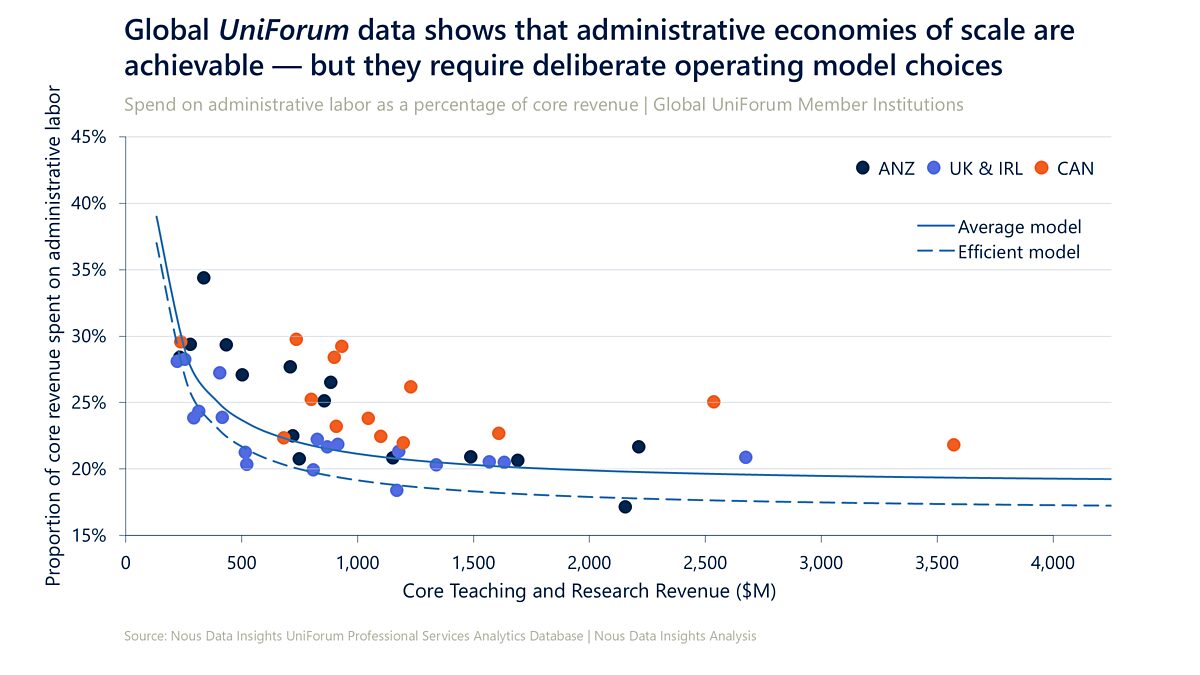
Monash University, in Australia, demonstrates what this approach can accomplish. Using transparent functional data, senior administrators and academic deans redesigned services across institutional boundaries. Based on Monash’s submissions to our UniForum data benchmarking program, they held administrative labor spending essentially flat while enrollment grew 45 percent over seven years, freeing resources for academic priorities. Harvard offers an emerging American example. It discovered that hiring a staff member could require 67 separate steps — surely not a process anyone had designed from beginning to end. Harvard is now asking a deceptively simple question: How many steps should hiring require? That is administrative re-engineering at its most practical: Redesign a discrete process to accomplish its legitimate purposes more simply and efficiently.
Administrative growth is not an unavoidable consequence of regulation or institutional complexity. Nor can it be controlled through periodic budget cuts. But it can be governed if leaders establish accountability for costs and services and redesign discrete functions end to end.
Taken together, these practices define a new stewardship that should lie at the heart of the social contract between universities and society. Universities must bring to administration the same rigor, evidence, and willingness to challenge inherited assumptions that they bring to scholarship. They will restore trust only by reducing administrative complexity, bending their administrative-cost curve, and redirecting resources to the academic mission.
View the Data Annex for this article.
Authors

Haseeb Kamal
Managing Director, North America
Haseeb has spent over 10 years advising clients in the education sector, spanning K-12 and higher education.